

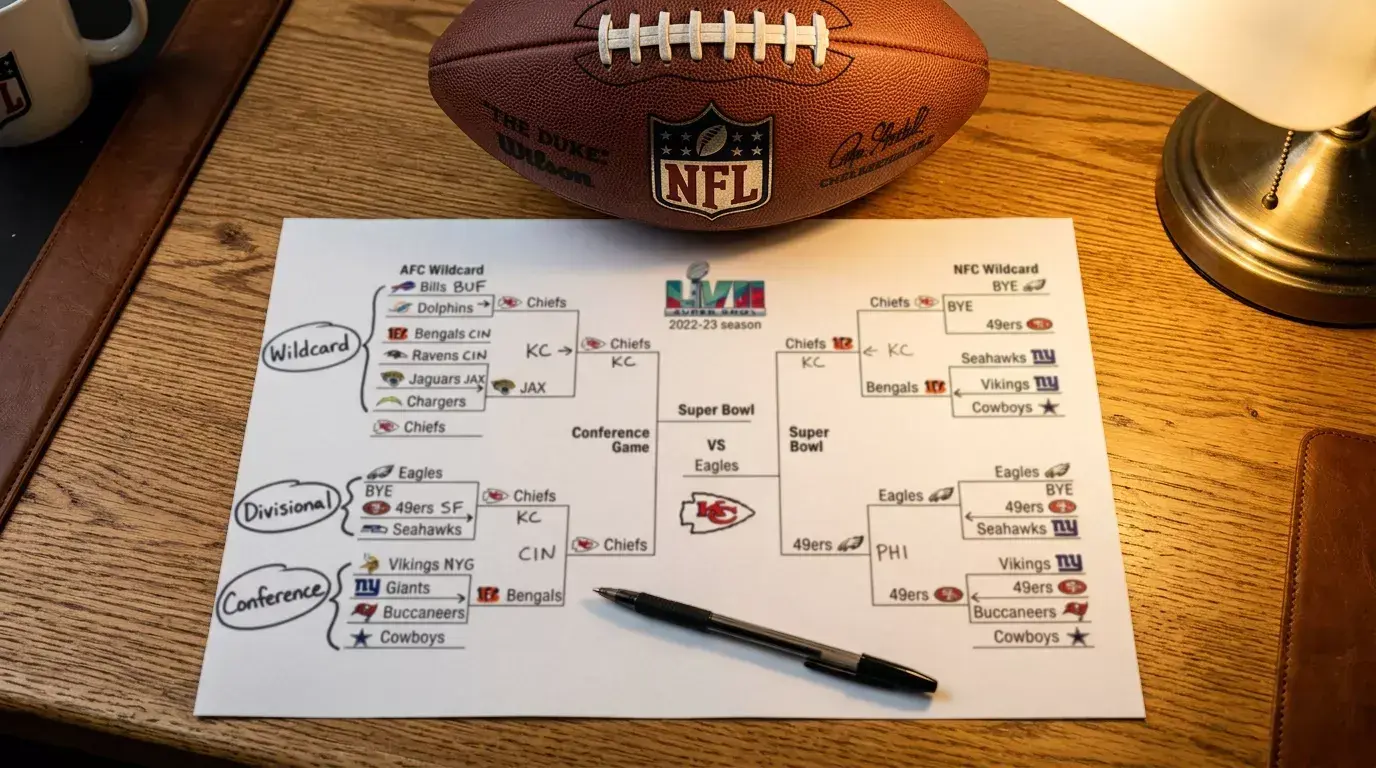
Thirteen games, three rounds, and a bracket on the kitchen table
The NFL playoffs deliver thirteen games across four weekends in January and early February, and for a UK punter every one of those games is a “win or go home” line where one team’s season ends. The weekly sheet that worked through the regular season transforms into a bracket – a tournament-style tracker where each round’s winners advance, each round’s losers are eliminated, and a punter’s outstanding futures positions on Super Bowl outright and conference champion move from speculative to operational. The playoff window is the most concentrated betting period of the NFL calendar, and it requires a different approach from the rhythm of regular-season Sundays.
This piece is strictly about the playoffs from Wildcard Weekend through the Conference Championships. It is not about Super Bowl betting specifically (that has its own structural characteristics) and not about regular-season strategy. The narrow question is: how does the playoff bracket structure shape betting markets, what are the historical trends in each round, and how should a UK punter organise their sheet across the three-weekend playoff window before the Super Bowl?
The UK audience for playoff games has grown substantially with the NFL’s commercial push into Britain. Sky Sports’ peak NFL audience in the UK has been measured at over 760,000 viewers for marquee playoff broadcasts, and the regular January playoff window now produces meaningful television numbers that justify deep market coverage from UK bookmakers. The break-even hurdle of 52.38 percent on standard handicap betting applies just as cleanly to playoff games as to regular season, and the structural patterns that move that hurdle in punters’ favour are worth the focused attention this short window requires.
The playoff bracket structure
The NFL playoff bracket includes fourteen teams, seven from each conference. The top seed in each conference receives a bye through the Wildcard round. The remaining six teams in each conference play the Wildcard round across six matchups (three in each conference). The four winners from each conference advance to the Divisional Round, where they join the top seeds to produce two same-conference matchups in each Divisional Round weekend. The two winners in each conference advance to the Conference Championship, and the two Conference Championship winners advance to the Super Bowl.
The Wildcard Weekend features six games across Saturday and Sunday – three in the AFC and three in the NFC. The Divisional Round features four games across Saturday and Sunday – two in each conference. The Conference Championships are two games on the final Sunday before the two-week gap to the Super Bowl. Including the Super Bowl, the playoff bracket totals thirteen games across four weekends.
The seeding determines home-field advantage throughout the playoffs. The top seed gets home-field advantage in both the Divisional Round and the Conference Championship, provided they win the Divisional Round. The other seeds host games based on their relative seeding within each round – a 2-seed hosts a 3-seed or higher seed, and so on through the bracket. The seeding logic produces predictable home-game patterns that UK punters can use to forecast which venues will host which rounds.
The international-game inclusion does not extend to the playoffs as of the current format. London-based or other neutral-site games are regular-season-only events; the playoffs play at the home venue of the better-seeded team. This is a fixed feature of the bracket structure that UK punters should not expect to change in the near future.
Wildcard Weekend trends and where they point
Wildcard Weekend produces six games across two days, and the structural betting patterns across the round are well-documented. The most consistent pattern is that road underdogs cover at slightly higher rates in Wildcard Weekend than in regular-season comparable matchups. The reason traces back to seeding economics: the higher-seeded home team has often coasted through the final weeks of the regular season after locking in their seed, while the road underdog has fought through must-win games to earn the playoff berth. The road team arrives in better mid-season form.
The aggregate ATS record of Wildcard road dogs across multi-decade samples has run at approximately 53 to 54 percent – narrowly above the break-even threshold. The pattern is most pronounced in cases where the home team’s seeding was determined by tiebreakers or by a soft schedule rather than by demonstrably better play. In those cases the betting market sometimes over-prices the home team’s record without adjusting for strength of schedule, and the road dog absorbs the discount.
The totals pattern in Wildcard Weekend tends toward the under. Aggregate scoring in Wildcard games runs roughly one to two points lower than the implied total at posting. The reasons combine the typical playoff-football phenomena (more conservative play-calling, more emphasis on ball-control, fewer high-variance decisions) with the cold-weather venues that often host Wildcard games. Many Wildcard home venues are northern cities in early January, with weather effects that suppress scoring.
The early-window versus late-window split matters too. The Saturday games (typically the early-window slate) feature lower-seeded teams playing in less prominent matchups, with broadcast pressure low. The Sunday games feature the marquee matchups with the heaviest betting volume. The Saturday Wildcard slate often produces less aggressive line movement and slightly thinner markets, while the Sunday slate moves more on public money.
Divisional Round and the rest advantage
The Divisional Round introduces a structural factor that does not exist in any other playoff round: the rest advantage. The top seeds in each conference enter the Divisional Round with two weeks of rest while their opponents played the prior Sunday. That extra week matters for recovery, game-planning, and health. It has produced one of the most reliable historical patterns in NFL playoff betting: top-seeded home teams in the Divisional Round have historically covered at rates well above break-even.
The standard interpretation is that the rest advantage is worth roughly half a point to a full point on the spread compared to regular-season home-field advantage. The bookmaker prices this advantage into the line – Divisional Round top seeds are typically priced at handicaps that reflect both their seasonal quality and the rest advantage. But the public-betting market sometimes underweights the rest advantage, particularly when the opposing team has come into the round on a hot streak. The home favourite at a 6.5-point line in the Divisional Round has historically been a marginally positive expected-value bet at standard handicap pricing.
The exception is the lower-seeded Divisional Round home team. In a Divisional Round where the higher seed lost in the Wildcard Round, the next-highest remaining seed hosts the surviving teams, and that lower-seeded home team did not have the bye-week rest. Their home-field advantage compresses back toward the regular-season baseline, and they should be priced accordingly. Bookmakers usually price this correctly, but the patterns of public money sometimes drift toward over-rating their home advantage.
Totals in Divisional Round games run closer to the listed line than in Wildcard games. The matchups are more competitive on average, both teams arrive with high motivation, and the rest advantage produces slightly higher-quality offensive performance from the rested home team. The under-bias that characterised Wildcard totals largely disappears in the Divisional Round, and the total markets price closer to their fundamentals.
Conference Championship pricing and what moves it
The Conference Championships are the two games where four remaining teams compete for the right to play in the Super Bowl. The structural betting characteristics differ meaningfully from the prior rounds. Both teams have advanced through two playoff rounds; both are now playing for a Super Bowl berth; and the matchups feature the four best teams in the league by playoff-determined standards.
The home-field advantage in Conference Championships sits at the upper end of the playoff range – roughly 2.5 to 3 points. The home crowd intensity is among the highest of the year, and the home team has earned the venue through seeding and prior performance. The aggregate ATS record of Conference Championship home favourites has been positive across long historical samples, though the magnitude has compressed in recent years as the betting market has incorporated the rest-and-home-field information more cleanly.
The totals on Conference Championship games tend to be more variable than in earlier rounds. The matchups can produce either grinding low-scoring affairs (when two strong defences meet) or high-scoring shootouts (when two elite offences meet). The pre-game total reflects the bookmaker’s pricing of the matchup; betting the total in Conference Championships requires confidence in the specific matchup analysis rather than reliance on round-level patterns.
The futures markets at this stage become highly active. The two surviving Conference Championship winners advance to the Super Bowl, so futures positions on those teams shift dramatically in implied probability across the week. The page covering Super Bowl betting sheet UK walks through how the Conference Championship outcomes set up the Super Bowl betting landscape, and reading them together gives UK punters the full picture of how playoff handicap betting feeds into the bigger Super Bowl markets.
Building a playoff bracket sheet
The shift from regular-season sheet to playoff bracket sheet requires a different structure. The regular-season sheet tracks each week’s slate against bookmaker lines and your own pricing; the playoff bracket sheet tracks survivors, outstanding futures positions, and the cascading implications of each game’s result.
The core layout for a playoff bracket sheet starts with the fourteen-team bracket at the top, showing both conferences and the seeding. The Wildcard round is the next section, with six rows for the six games and columns for handicap line, total line, your fair-price estimates, and your selected stakes. The Divisional Round is laid out below with four rows, the Conference Championships with two rows, and the Super Bowl with one row.
The bracket sheet tracks survivors after each round. When Wildcard Weekend resolves, you update the Divisional Round rows with the actual matchups and the freshly posted lines. The same process repeats for the Conference Championships, then for the Super Bowl. The sheet also tracks your outstanding futures positions – Super Bowl outright, conference champion, division winner that has cascaded into playoff success.
The discipline that works is to set stake sizes at the start of the playoffs and stick to them across rounds. The temptation to chase losses or to press hot streaks is at its highest during the concentrated playoff window because the games are emotional, the variance is high, and the gap between rounds is short. A pre-committed staking strategy across the bracket – for example, fixed stakes per round with a small uplift to the Conference Championships and Super Bowl – produces better long-term outcomes than discretionary in-the-moment sizing.
