

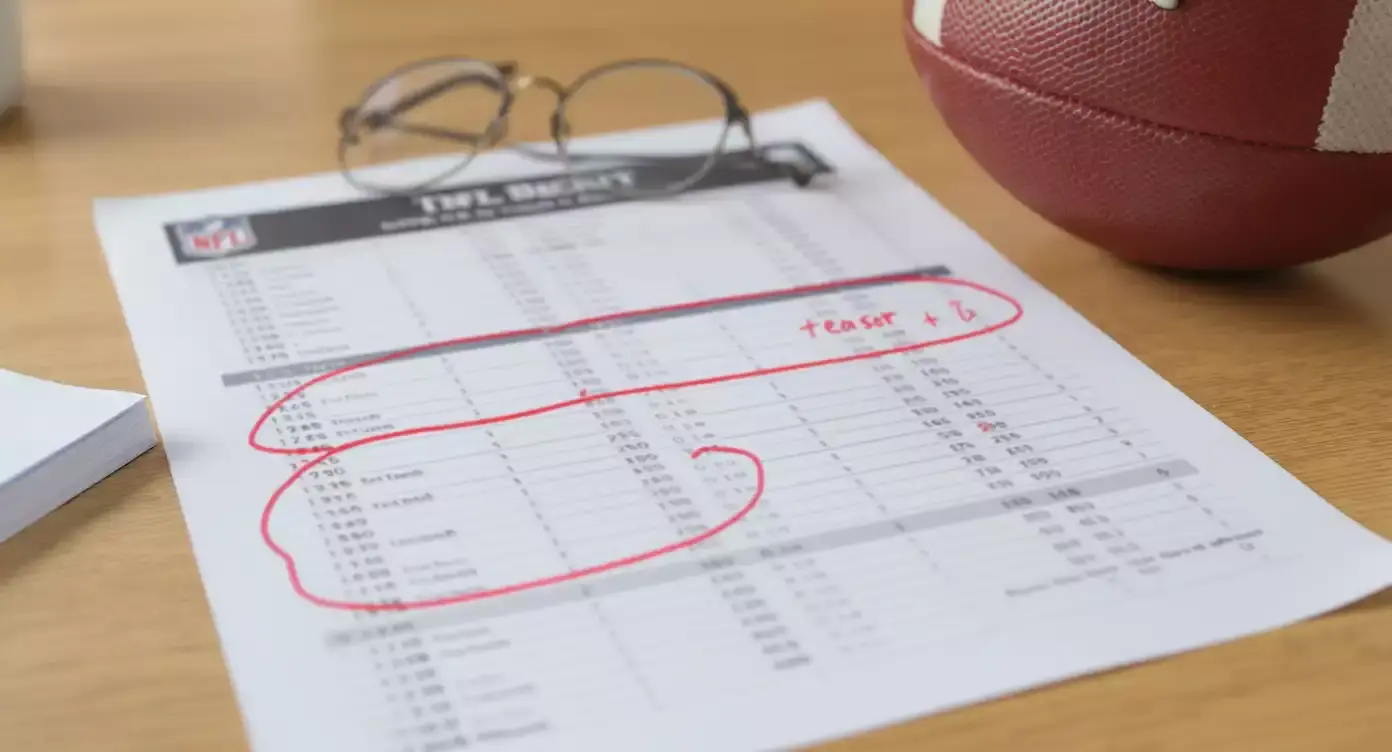
The word that almost nobody at a UK betting counter uses

Walk into a William Hill on a Saturday afternoon and ask for a six-point teaser on the Bengals and the Eagles, and the clerk will look at you the way I once looked at a colleague who asked for a yard of bitter. The word “teaser” barely exists in the UK punter vocabulary. We talk about accumulators, request-a-bets and bet builders; teasers belong to the American sportsbook glossary, and most UKGC-licensed operators do not even offer them by default. That gap matters, because a teaser is one of the few NFL bet types that gives the punter a structural way to lean on the league’s most important statistical quirk – the concentration of margins around three and seven.

What I want to do in this piece is keep the focus tight on teasers as a product. Not parlays. Not bet builders. Not key numbers as a general concept. The teaser specifically, in its 6-point, 6.5-point, 7-point and 10-point variants, with a serious look at the Wong teaser and where positive expected value actually lives. By the end you should know exactly when a teaser is worth the trade-off and when it is a fancy way to give the bookmaker a wider margin.

What a teaser actually is, with the maths exposed

A teaser is a multi-leg bet, like an accumulator, but with one crucial twist: the punter gets to shift the spread on each leg by a fixed amount in their favour, in exchange for accepting shorter combined odds. Two-leg six-point teaser, Bengals minus seven becomes Bengals minus one, Eagles minus three becomes Eagles plus three. Both legs still need to win, but each leg now sits on a much more comfortable spread.

The trade-off is brutal on the odds side. A standard two-leg accumulator at evens each leg pays roughly 3/1 if both legs cover. A two-leg six-point teaser pays around 5/6 – slightly worse than even money. Punters used to UK accumulator culture often look at that 5/6 price and walk away, because the maths feels backwards. Why would I take 5/6 on two legs when I could take 3/1 on the same two teams without the teaser adjustment?

The answer lives inside the NFL margin distribution. Over 15 percent of all NFL games since 1989 have been decided by exactly three points – almost twice as common as the next most-frequent margin – and roughly 9 percent of NFL games end with a 7-point margin. Together those two key numbers eat nearly a quarter of all NFL outcomes. Move a spread by six points and you cross both numbers, and the historical probability of winning your leg climbs from about 50 percent to somewhere between 70 and 75 percent depending on the starting spread. That probability uplift, compounded across two legs, mathematically beats the lower price – provided you choose your legs carefully.

The 6-point, 6.5-point, 7-point and 10-point family

Not all teasers are six points. The American sportsbook menu typically offers four standard tiers, and the few UKGC firms that have launched the product follow the same convention. Each tier represents a different trade between the spread shift and the price reduction.

Six-point teasers are the classic and the most analysed. Two-leg six-point teasers historically pay around 5/6 (decimal 1.83), three-leg around 9/5 (decimal 2.80), and four-leg around 3/1 (decimal 4.00). The six-point shift is the precise width that crosses both key numbers three and seven without overshooting, which is why this tier carries the bulk of the academic research on teaser value.

Six-and-a-half-point teasers exist at some books and offer a marginal extra cushion at a slightly worse price – typically 4/5 on two legs instead of 5/6. The extra half-point matters most when a leg sits on a starting spread of plus or minus three, because shifting from minus three to plus three-and-a-half puts you on the right side of every three-point margin in the historical sample.

Seven-point teasers crack across the seven-point key number with breathing room on both sides – a leg starting at minus seven becomes plus seven, and a leg starting at minus six becomes plus eight. The price drops further. Two-leg seven-point teasers typically pay 4/6 (decimal 1.67). The trade-off only makes sense when both legs originated on starting spreads tightly clustered around seven, which is structurally rare.

Ten-point teasers are the marketing product. Big spread shift, terrible price – two-leg ten-point teasers pay around 4/9 (decimal 1.44), meaning you stake £9 to win £4. The bookmaker prices these to lose value over time, and unless you have a very specific reason to want a ten-point cushion on every leg, the maths runs against you.

The Wong teaser and why it actually works

Stanford Wong, a professional gambler whose actual name is John Ferguson, published the original research on a specific subset of six-point teasers in 2001. His finding was that two-leg six-point teasers built only from underdogs in the plus 1.5 to plus 2.5 range and favourites in the minus 7.5 to minus 8.5 range produced a long-run positive expected value at the standard 5/6 price. That subset is now called the Wong teaser.

The logic comes back to the key numbers three and seven. An underdog at plus 2.5 teased six points becomes plus 8.5 – across both three and seven. A favourite at minus 8.5 teased six points becomes minus 2.5 – across both seven and three from the other direction. Either way, the teased line sits on the safe side of both key numbers, and the cumulative effect on historical win probability is enough to beat the 5/6 price.

The original Wong research drew from pre-2015 data, and the 2015 NFL rule change moving the extra-point kick back to the 15-yard line dropped the kick conversion rate from 95.2 percent to 90.7 percent, which marginally increased the share of 6- and 8-point games at the expense of 7-point games. That shift narrows the Wong teaser edge slightly but does not eliminate it. The mathematical structure still holds – three and seven remain the dominant margins, and the spread bands either side of them remain the most teasable starting points.

The discipline that matters here is leg selection. A Wong teaser built on the wrong starting spreads – say, a favourite at minus four and an underdog at plus six – loses the key-number advantage entirely and turns into a poor-value bet. The Wong band is narrow on purpose. If your two legs do not fall inside it, you do not have a Wong teaser; you have a regular six-point teaser, which is roughly break-even at fair pricing and a small loser at most UK operators.

What teasers actually cost at the UK firms that offer them

UKGC-licensed bookmakers have been slow to add teasers to their NFL menus, and the small number that do offer them tend to price the product less favourably than US sportsbooks. The standard 5/6 two-leg six-point teaser benchmark sometimes drops to 4/6 or even 4/7 at UK firms, which kills the Wong edge before you start.

The pricing gap exists for two reasons. First, the UK market for NFL teasers is small, so operators feel less pressure to offer competitive odds – they can charge a premium and still capture the punters who want the product. Second, UK firms are accustomed to pricing accumulators with shorter combined odds because UK punters historically tolerate worse acca prices in exchange for the volume of acca bonuses. That tolerance gets imported into the teaser line and weakens the product.

The practical implication is that finding a UK-priced teaser at fair odds requires line-shopping discipline. The same product can be priced 5/6 at one operator and 4/6 at another for an identical two-leg structure, and the difference is the entire edge. UK punters should also note that some operators only offer teasers as a hidden option inside their bet builder or request-a-bet flow, which means the headline NFL markets page never advertises the product at all. You have to dig.

The narrow conditions where positive expected value lives

I want to be honest about how narrow the teaser edge actually is. A correctly constructed two-leg six-point Wong teaser at fair 5/6 pricing returns roughly 105 to 108 percent of stake over a sufficiently large sample – a 5 to 8 percent edge per bet, before accounting for variance. That is a real edge, but it is not a license to teaser-bet every Sunday. The Wong band is narrow, the pricing has to be right, and a single bad leg selection wipes out a season’s worth of careful work.

I run my Wong teasers on a strict checklist. Both legs sit in the Wong band on their starting spread. The combined teased lines cross both key numbers. The bookmaker offers the bet at 5/6 or better on two legs, 9/5 or better on three. Neither leg involves a team carrying significant injury uncertainty – a starting-QB question on either side blows up the original spread research because the line was priced for a different team. And both games run independently, not as part of the same divisional matchup, to avoid hidden correlation.

If any of those conditions fail, the bet does not go on. Teasers are a tool, not a strategy. The strategy is built around the key numbers themselves, and the teaser is one way to express it. If you want the full underlying maths on why three and seven dominate the NFL margin distribution, my piece on key numbers for UK NFL bettors walks through the historical data in more detail.

FAQ

Which UK bookmakers actually offer NFL teasers?
The teaser product is rare on UK menus. A small handful of operators have offered it as a US-style import, usually inside their request-a-bet or build-your-bet flow rather than on the main NFL markets page. Punters serious about teasers tend to shop across multiple UKGC-licensed firms each week to find the product priced at fair odds.
Why is the Wong teaser considered profitable in NFL?
The Wong teaser only includes legs on specific starting spreads – underdogs at plus 1.5 to 2.5 and favourites at minus 7.5 to 8.5 – that allow the six-point shift to cross both key numbers three and seven safely. The cumulative win probability across two such legs has historically beaten the 5/6 price the standard teaser pays.
How does a teaser differ from a same-game accumulator?
A teaser combines legs from different games and lets the punter shift each spread in their favour by a fixed amount, in exchange for shorter combined odds. A same-game accumulator combines correlated legs from one fixture and prices them with a correlation adjustment, with no spread shift. Teasers are about manipulating the line; same-game accumulators are about combining outcomes.