
The Maths That Outlives the Picks
I have watched sharp NFL bettors blow up their season because they sized stakes wrong, and mediocre pickers grind out profits because their staking was disciplined. The picks matter less than the staking. A 53 percent win rate at minus 110 is profitable across a year if your unit sizing is right. The same win rate with reckless staking can produce a six-week stretch that wipes the bankroll before variance evens out.
The simple version: 1 percent of bankroll per bet turns a £500 starting bank into 100 bets of runway. That absorbs a 15 or 20-bet losing streak – statistically common in NFL spread betting – without going broke. Drop the unit size to 5 percent and a normal losing streak ends your season.
This article is specifically about staking and bankroll structure, not responsible gambling in the broader regulatory sense – that has its own resources and support routes. What follows assumes you have already decided what an appropriate gambling bankroll looks like for your circumstances, and the question is purely how to deploy it efficiently across an NFL season.
Defining Unit Size and Why It Anchors Everything
A unit is the base stake you apply to a standard bet. Most disciplined NFL bettors use 1 percent of their starting bankroll as one unit. A £500 bank means a 1-unit bet is £5. A £2,000 bank means a 1-unit bet is £20. The number is small enough that no single bet matters, which is the entire point – your edge has to play out across hundreds of bets, and any individual outcome is noise.
The mistake most punters make is sizing bets relative to confidence rather than bankroll. A “strong play” gets 5 units, a “regular play” gets 2 units, a “lean” gets half a unit. That structure feels reasonable until you actually back-test it. Confidence is a poor predictor of outcome – the bets a bettor feels strongest about hit at a rate not meaningfully different from their overall rate. Variance does not respect conviction.
My preferred structure is flat staking with very narrow variation. Most of my NFL bets are 1 unit. A small number – maybe 5 to 10 percent of total volume – are 1.5 units when I have a specific structural advantage (price discrepancy across books, late line movement against my number, situation I have modelled and validated). I do not stake more than 2 units on any single NFL game, ever. The variance reduction of capping max stake is worth far more than the upside on the occasional huge edge.
The other anchoring decision is whether to rebase unit size during the season. Some bettors recalculate units weekly based on current bankroll – a winning streak grows the unit, a losing streak shrinks it. Others fix the unit at the season-start bankroll and only adjust at year-end. I prefer the fixed approach. Rebasing mid-season amplifies both upside and drawdown, and the psychological discipline of betting the same notional amount through hot and cold streaks is genuinely valuable.
Flat Staking Versus Percent-of-Bankroll Staking
Flat staking is exactly what it sounds like: you bet the same nominal amount on every bet regardless of bankroll fluctuation. £20 a game, every game, until the season ends. The advantage is psychological simplicity and the absence of compounding variance – your drawdowns are linear, your wins are linear, and you always know exactly what is at stake.
Percent-of-bankroll staking adjusts the bet size to current bankroll. If you start at £2,000 with a 1 percent unit (£20) and your bank grows to £2,400, your new unit becomes £24. If it drops to £1,600, your unit drops to £16. The mathematical advantage is that you cannot go bust – each loss reduces the next stake, so the bankroll asymptotically approaches zero rather than crossing it. The disadvantage is that drawdowns recover more slowly because each winning bet during a recovery phase is smaller than during the peak.
The two approaches produce meaningfully different outcomes over a season. Flat staking with a positive edge produces a steady linear equity curve. Percent staking produces a concave curve that grows slower on the way up but loses less on the way down. For a bettor with a small edge – and most realistic edges in NFL betting are small – the smoothness of percent staking is valuable.
There is a hybrid I use in practice: flat staking within a season, with the unit rebased once a year. I bet £20 a game from Week 1 through Week 18 plus playoffs. At year-end I recalculate 1 percent of the final bankroll, and that becomes the new unit. This combines flat-staking simplicity with long-term compounding while avoiding within-season noise.
The 52.38 percent break-even threshold on standard minus 110 odds is the number that anchors all of this. You need to win at least 52.38 percent of your spread bets just to break even – and most UK NFL punters bet significantly worse than that, which is why the bookmakers stay profitable. At minus 115 the break-even rises to roughly 53.49 percent. Bankroll management does not change those thresholds; it just determines whether you survive long enough for your win rate to express itself.
Kelly Criterion and the Traps That Come With It
The Kelly criterion is the mathematically optimal stake size for a given edge and odds. The formula is straightforward: stake equals edge divided by odds, where edge is the percentage probability advantage you have over the market price, and odds is the decimal price minus one. For a bet at 2.00 (evens) where you assess a 55 percent win probability, Kelly says you should stake 10 percent of your bank.
10 percent of bank is enormous. Full Kelly produces extreme volatility because it sizes aggressively when the perceived edge is large. A season of full-Kelly NFL betting would routinely produce drawdowns of 50 percent or more, even with a positive edge, because the variance of NFL outcomes is so high that long losing streaks happen regularly within positive-EV strategies.
The first trap with Kelly is that it depends entirely on knowing your true edge. If you think your edge is 5 percent but actually it is 1 percent, Kelly sizing massively overstakes every bet. Most punters consistently overestimate their edge – sometimes by a factor of three or four – and full Kelly applied to an overestimated edge is a fast route to ruin.
The second trap is that Kelly assumes the bets are independent, which they are not in NFL betting. Multiple bets on a single Sunday are correlated through league-wide variables – weather patterns, market shifts, scheduling effects. Kelly applied bet-by-bet without correlation adjustment overstakes any given Sunday’s exposure relative to its true risk profile.
The standard adjustment for practical bettors is fractional Kelly – quarter or half Kelly. Quarter Kelly produces about a quarter of the drawdown of full Kelly while sacrificing roughly a quarter of the long-term growth. For most UK NFL punters, flat staking at 1 to 2 percent of bank is the more pragmatic answer than any form of Kelly.
Drawdown Tolerance for UK Punters
A drawdown is the peak-to-trough decline in your bankroll. Even a profitable strategy will experience drawdowns; the question is how large they get and how you respond to them. The maximum drawdown across an NFL season for a 53 percent flat-stakes bettor at 1 percent units can easily reach 25 to 30 percent of starting bank. For a 55 percent bettor – exceptional by any measure – the typical season drawdown is still 15 to 20 percent.
“Sharp bettors typically wager on 20 to 30 percent of available games, focusing only on spots where they identify genuine edges. They also understand that NFL betting is a long game. A 55 percent win rate is excellent and profitable at minus 110 odds,” noted the Betvisors editorial on NFL spread betting strategy. The phrase that matters there is “long game” – variance smooths out across hundreds of bets, not dozens, and the drawdowns in between are part of the territory.
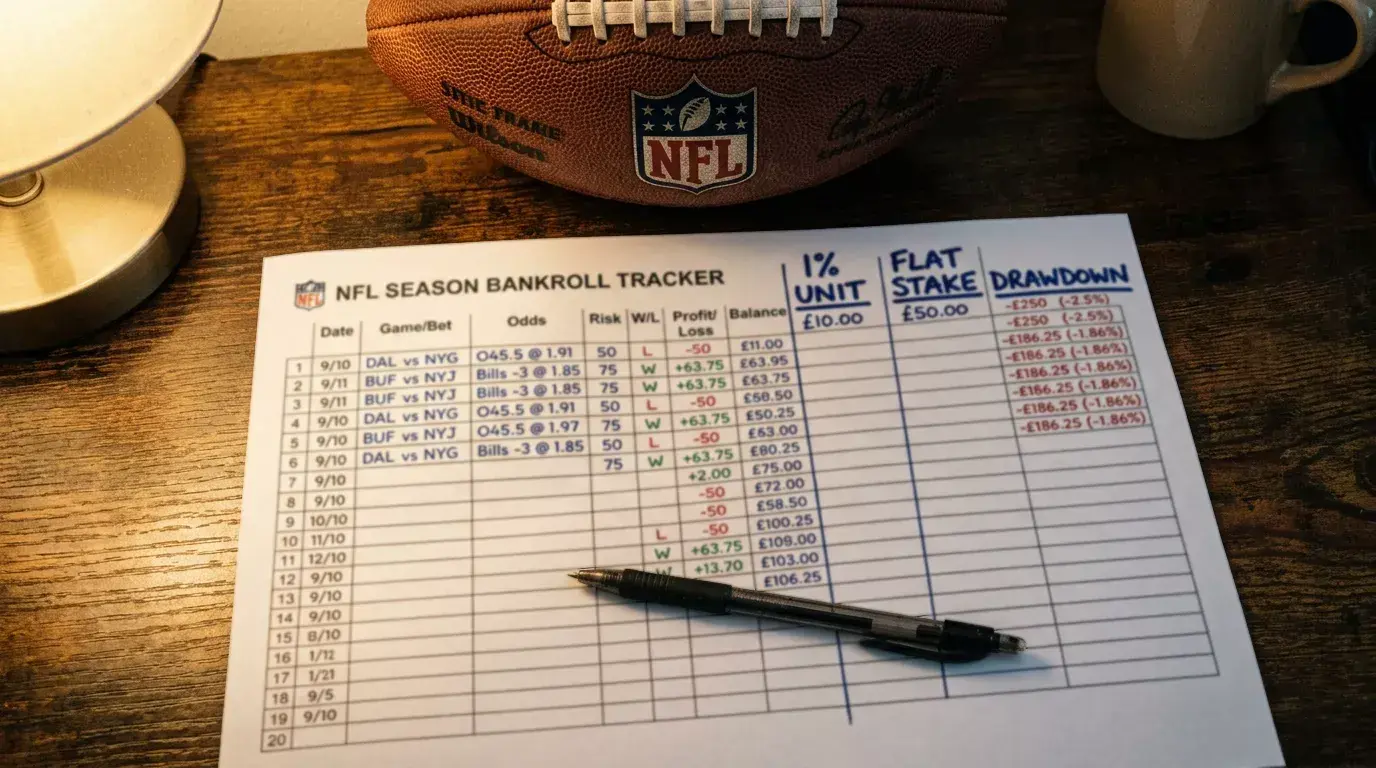
The behavioural mistake during drawdowns is increasing stake size to chase losses. This is the single fastest way to convert a manageable bad stretch into a bankroll-ending event. The structural answer is to fix the unit size before the season starts and not allow yourself to deviate during the season – write it down, send yourself a constraint email, whatever it takes to make the decision in advance rather than in the moment.
The other drawdown response that helps is tracking. If you maintain a clean log of every bet, with your model’s expected probability versus the actual market price, you can distinguish between “I am running bad” and “my model is broken”. A drawdown in which your expected close-line values remain positive is variance. A drawdown in which your expected values are deteriorating is a signal to stop and review. The 0.5 percent of UK adults categorised as high-risk problem gamblers represents the population that does not maintain this distinction – they keep betting when both variance and process are working against them.
Bankroll Reset Rules and Season Boundaries
The NFL season has natural boundaries: the regular season ends, the playoffs end, the Super Bowl ends, the offseason starts. Those boundaries are useful for bankroll resets, because they create natural moments to recalibrate without disrupting the in-season discipline.
My personal reset rule is end-of-Super-Bowl. Final bankroll on Super Bowl Sunday becomes the basis for the next year’s unit calculation. If the season was profitable, the new unit is larger. If the season was unprofitable, the new unit is smaller – and that smaller unit is a survival mechanism, not a punishment. A losing season followed by larger-stake recovery attempts is how punters compound failure.
For punters running multiple bet types – spreads, totals, props, parlays, futures – the reset is also a moment to review allocation. If 60 percent of stake volume went into spreads and 40 percent into props but the actual edge came entirely from props, next season’s allocation should shift accordingly.
Mid-season interventions should be rare. The only reasons I would touch unit size during a season are a major life change (income, expenses) or a fundamental model adjustment after demonstrable evidence the original approach is flawed. Neither happens often, and the default should be to ride out drawdowns within the structure rather than restructuring under pressure. My broader weekly process for NFL betting – including the discipline of how I lay out the slate before lines are even released – is documented in detail in the printable NFL weekly sheet template, which is the foundation document for the bankroll structure above.
One final point on the offseason. Bankroll management does not pause between seasons. The temptation to bet preseason, college bowl games, or other gridiron content to keep the action flowing is real, and it can erode the bankroll that took an entire NFL season to build. I treat the offseason as a true offseason – no NFL-adjacent betting, light recreational stakes on other sports if at all, and a hard pause that resets discipline before Week 1 of the next campaign. The bankroll exists to be deployed during the season. Protecting it between seasons is part of the same job.
